A new rule in baseball and a lesson to remember.
Tag: Tazria
-
Harry’s Video Blog – The Slap at the Oscars – Parshat Tazria 5782
What timely lesson can we learn from a slap seen around the world?
-
Rabbi Mordechai Becher’s VLog – I’m A Jew – Parshat Tazria/Metzora 5781
Rabbi Mordechai Becher proclaims, “I’m A Jew – and I Won’t Apologize to You!”
Find out who wants him to apologize and why the good Rabbi won’t even consider it! -

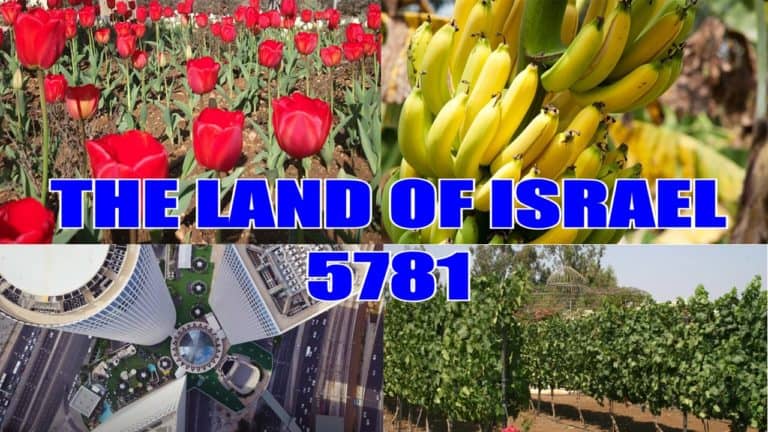
The Land of Israel – 5781
The counting of the Omer is intimately connected to the Land of Israel, declaring the first crops of the land as belonging to God, and acknowledging His gift to our people of the land of Israel. The first commandment God gave to the first Jew was to go to the Land of Israel God spoke to Abraham, and said, ““Go for yourself, from your land, from your relatives and from your father’s house to the land that I will show you.””[1] Abraham, Sarah, their family and their retinue all came to Israel, then known as Canaan. They traveled around the land, engaged in commerce and, of course, in spreading monotheism.[2] They lived in the mountains of Bet-El on the west bank of the Jordan; in Be’er Sheba in the Negev Desert; and in the city of Hebron. God promised Abraham that although his descendants would go into exile and be enslaved, ultimately, He would free them, bring them to Israel, and make Israel the eternal homeland of Abraham’s descendants.[3]
The Patriarchs, Matriarchs, and the children of Jacob (the Twelve Tribes), lived in and were buried in Israel. Abraham and Sarah, Jacob and Rebecca, Isaac and Leah were buried in Hebron, in the cave purchased by Abraham; Rachel was buried on the road to Bethlehem, and Joseph was buried in Shechem. Although he died in Egypt, Joseph ordered that his body be embalmed and not buried, so that the Jews would take it with them at the time of the Exodus, and bury it in Israel.[4]
Following Joshua’s conquest of Israel the Jews lived there as an independent commonwealth and later under a monarchy for 800 years. Judges ruled the people for almost 400 years until the reign of the first king, King Saul. Saul was succeeded by King David, who was followed by his son, Solomon. Solomon built the First Temple in Jerusalem, the capital of Israel. This Temple stood for 410 years until it was destroyed by the Babylonians, who conquered Israel and exiled the Jews to Babylon.
By the Rivers of Babylon…
Although the Jewish people were in exile they did not forget Israel. Their emotions were prophetically described by King David in Psalm 137:
“By the rivers of Babylon, there we sat and also wept when we remembered Zion… If I forget you, O Jerusalem, let my right hand forget its skill. Let my tongue adhere to my palate, if I fail to recall you, if I fail to elevate Jerusalem above my foremost joy…”
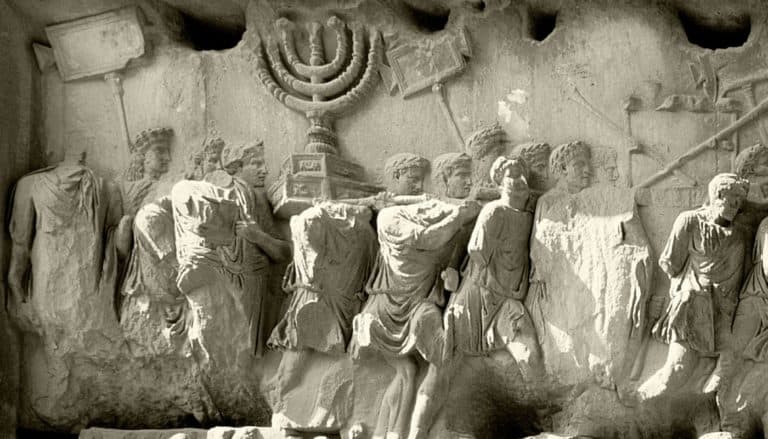
After seventy years in Babylon, Ezra and Nechemiah led many exiles back to Israel where they built the Second Temple. The Jewish Commonwealth was renewed and the Temple services were once again performed in Jerusalem. The Jews lived in Israel from the time of their return until the Roman destruction of the Temple and subsequent exile in 70 CE, about 420 years later.
We Shall Not Be Moved
Despite all the invasions, exiles and hardship, two Jewish states existed in Israel, the first lasting for 840 years, the second for 420 years. Even during the long exile that followed the Roman destruction of the Temple a continuous Jewish presence was maintained in Israel. The land was invaded by Arabs, Crusaders, Saracens, Mongols, Mamluks, Ottomans and the British, but through it all Jews not only remained there but produced monumental works of learning and liturgy. Rabbi Judah the Prince wrote the Mishnah in northern Israel in 200 CE and the Jerusalem Talmud was edited there in 350 CE. Rabbi Joseph Karo wrote the Code of Jewish Law in Safed in the 16th Century, and the song, Lechah Dodi, was composed by Rabbi Shlomoh Alkabetz, student of the great Kabbalist of Safed, Rabbi Yitzchak Luriah (AriZal) in the 16th Century.
During this period many Jews immigrated to Israel from other lands. The great scholar Nachmanides came from Spain and established a synagogue in Jerusalem in the 13th Century. In the time of Ottoman rule, groups of Hassidim came to Israel on the instruction of their leaders in Europe. The Gaon of Vilna sent many students to settle in Israel, and in the late 19th Century, the Zionist movement brought thousands of people to Israel to establish agricultural settlements and industry there. The attachment of the Jews to their land throughout over 1900 years of exile culminated in the establishment of the State of Israel in 1948, now home to over five million Jews. Jews of the 21st century take for granted the presence of Jewish communities in Israel. From a historical point of view, however, the return of a people to their land after nineteen centuries of exile, the establishment of an independent Jewish state, and the ingathering of Jews from virtually every country in the world are miraculous and unprecedented events in history.
Land of the Spirit
The land is not only distinguished by its history, but also by its intrinsic, spiritual qualities. Most prophets either lived in Israel or prophesied about it. Jewish philosophers consider prophecy to be a product of the Land. Based on the principle that the structure and nature of the physical world reflects the underlying spiritual nature of reality, Rabbi Yehudah Halevi explains that the spiritual capacity to produce prophecy is similar to the physical capacity to grow crops. Different regions have the capacity to grow certain crops better than other places. So too, different areas have different spiritual influences and potentials. Israel has the capacity to cultivate prophecy, connection to God and intense spirituality more than any other place in the world. It is not a coincidence that many religions feel a special connection to Israel, that the bulk of the Bible was written in Israel and that the Psalms, which form the basis of prayer for literally hundreds of millions of people around the world, were written in Israel.
Of the 613 commandments of the Bible, 343 are directly dependent on the Land of Israel — that is, fully 56% of Jewish law is, in some way, contingent upon being in Israel. Even those commandments that are not directly dependent upon the land have a different and deeper spiritual dimension when performed in Israel.[5]
The Shechinah Is Here
The Hebrew word Shechinah means “Divine Presence.” Although in reality, God permeates all of time and space equally,[6] we are not able to perceive His presence equally in all times and all places.[7] There are moments when God allows us more of a glimpse of the Divine Presence — at sunset towards the end of the Day of Atonement, for instance. There are also places where God allows us a greater degree of perception, such as Israel. The Torah calls Jerusalem the “Gates of Heaven”[8] and our Sages point out that even after the destruction of the Temple, the Divine Presence has never left the Western Wall.[9]
Tens of thousands of Jews from all over the world, representing every level of religiosity, and of knowledge, visit the Western Wall every year. The Western Wall, (the Kotel) is the westernmost retaining wall of the Temple Mount, and dates from the Second Temple era. Many Jews who visit have no knowledge of the Temple at all, many know little or nothing about Judaism or Jewish history. And yet, the Wall draws them like a magnet and often elicits from them deep spiritual feelings. For many people, a visit to the Wall has changed their lives by prompting them to investigate their Judaism. We believe that much of this remarkable energy is due to the fact that the “Shechinah never left the Western Wall.”
Special Surveillance
The Torah describes Israel as,
“A land that the Lord, your God, seeks out; the eyes of the Lord, your God, are always upon it, from the beginning of the year to year’s end.”[10]
The degree to which Divine Providence is manifest in Israel is much greater than anywhere else in the world.
A striking example of this special Providence is described in the prophecies of exile and redemption. The Torah predicted that the Jews would be exiled from Israel and that during that time the land would be desolate —
“I will make the land desolate; and your enemies who dwell upon it will be desolate. And you, I will scatter among the nations…”[11]
This ominous prediction is actually a blessing in disguise. God guarantees to the Jewish people that while they are in exile the land will not accept other inhabitants and will remain barren and desolate until their return. During the period of the first two Jewish commonwealths, the Land of Israel was renowned for its produce, was heavily forested and supported a large population. It was a land described by the Torah as “flowing with milk and honey,”[12] a “land with streams of water, of springs and underground water coming forth in valley and mountain; A land of wheat, barley, grapes, figs, and pomegranates; a land of olive oil and date-honey.”[13]
Contrast these descriptions with what eyewitnesses wrote about the land when the Jews where in exile. When Nachmanides immigrated to Israel in the 13th Century he wrote the following letter describing the desolation of Jerusalem:
“What shall I tell you about the land? There are so many forsaken places, and the desolation is great. It comes down to this: the more sacred the place, the more it has suffered – Jerusalem is most desolate, Judea more so than the Galilee. Yet in all its desolation it is an exceedingly good land.”[14]
When Mark Twain visited Israel 600 years later, the landscape was just as bleak:
“…[a] desolate country whose soil is rich enough, but is given over wholly to weeds — a silent mournful expanse…. A desolation is here that not even imagination can grace with the pomp of life and action…. We never saw a human being on the whole route…. There was hardly a tree or a shrub anywhere… No landscape exists that is more tiresome to the eye than that which bounds the approaches to Jerusalem… Jerusalem is mournful, dreary and lifeless. I would not desire to live here. It is a hopeless, dreary, heartbroken land… Palestine sits in sackcloth and ashes.”[15]
Today Israel has flowered once again — it exports tulips to Holland, has a thriving, internationally acclaimed wine industry, and produces an incredible variety of fruits, from tropical pineapples, mangos and bananas to cold-climate fruits such as apples and pears. In the Jerusalem forest all the species that flourished in Biblical times, grow wild. Israel’s children have started to come home and the land is welcoming them. As Ezekiel wrote some 2,500 years ago,
“But you, O mountains of Israel, shall give forth your branch and bear your fruit for My people Israel, for they are soon to come.”[16]
—————————
[1] Genesis 12:1-2
[2] Ibid. 12:8, Nachmanides ad loc.; Ibid. 21:33, Rashi, ad loc.
[3] Ibid. Ch. 15
[4] Genesis 50:24-26
[5] Nachmanides, Commentary on the Torah, Leviticus 18:25; Deuteronomy 11:18
[6] Zohar, Raya Meheimnah 3:225a; Rabbi Chaim Volozhin, Nefesh HaChaim, Sha’ar 3, Ch. 4
[7] Ibid. Sha’ar 3, Chs. 5-6
[8] Genesis 28:17; See also Shnei Luchot Habrit, Notes to Tractate Tamid, Ner Mitzvah 13, First Note; Teshuvot Chatam Sofer, Responsa Yoreh Deah, 233
[9] Midrash, Shmot Rabba, 2:2; Midrash Tanchumah, Shmot 10; Midrash Tehillim 11:3
[10] Deuteronomy 11:12
[11] Leviticus 26:32-33
[12] Exodus 3:8, 13:5, 20:24
[13] Deuteronomy 8:7-8
[14] Nachmanides, Collected Writings of Nachmanides, Edited by Charles B. Chavel, Mossad Harav Kook, Jerusalem, 1978. P. 378
[15] Mark Twain, Innocents Abroad or the New Pilgrims Progress: Being Some Account of the Steamship Quaker City’s Pleasure Excursion to Europe and the Holy Land, London: 1881 (New American Library, 1997).
[16] Ezekiel 36:8; See also Babylonian Talmud, Sanhedrin 98a; Rashi ad loc.
-
Rabbi Mordechai Becher’s VLog – Counting Time and Creating Time – Parshat Tazria/Metzora 5780
G-d created the Sunday-to-Shabbat week, but Jews create the weeks from Pesach until the giving of the Torah on Shavuot.
-

The Best of Times; The Worst of Times
For the Jewish people who came out of Egypt, the period between the Exodus and the Revelation at Mt. Sinai was one of continuous spiritual awakening. Their relationship with God grew stronger and closer. Miraculous events occurred daily. For the Jewish people in subsequent generations, this period continues to be one of the greatest of times of the year, in which we prepare ourselves for a renewal of our commitment to the Torah on Shavuot.
Jewish mystical tradition teaches that there are fifty levels of sanctity and opposing them, fifty levels of impurity. The Jewish people in Egypt (with some exceptions) had sunk to the forty-ninth level of impurity. Most of them believed in Egyptians deities and superstitions and were almost completely devoid of faith in God. It was only God’s decision to save them from Egypt when He did, that prevented them from falling to the fiftieth and lowest level, from which they would never have been able to rise. The forty-nine day period from the Exodus until Shavuot was (and still remains) a time when the Jewish people are able to ascend through the levels of sanctity and knowledge to reach the level of Revelation of the Torah on the fiftieth day at Mt. Sinai. Accordingly, counting the Omer measures our readiness to accept the Torah.
In the first century of the Common Era, the Jewish people experienced a major tragedy during the period of counting the Omer. The greatest sage of the generation was Rabbi Akivah, who taught vast numbers of people. The Talmud relates that 24,000 (!) of Rabbi Akivah’s students, who constituted the primary chain of Torah transmission, died as a result of an epidemic between Passover and Shavuot. It further states that the reason for this Divine punishment was that they did not treat one another with sufficient respect.
One of the greatest Jewish philosophers and Kabbalists, the Maharal of Prague, explains the Talmud’s statement in this way: since the period from Passover to Shavuot is the time of preparation for receiving the Torah — and these students were the central transmitters of Torah — any flaw in the process of receiving and transmitting the Torah was judged by God with extreme gravity. The lack of proper respect for a colleague demonstrates deficient understanding of the intrinsic, infinite potential of the human soul. Had the students fully appreciated this hidden potential, had they looked at their colleagues beneath the surface, their respect for each other would have been tremendous.
Respect for a colleague with whom one studies Torah is also a reflection of the respect one has for the Torah itself and for the vast treasure hidden beneath its surface. During the counting of the Omer, one of our primary tasks is to develop respect and honor for the Torah and for those who are devoted to it. The students of Rabbi Akivah failed in this task and therefore could not be the primary transmitters of the Torah. They had to be replaced. Rabbi Akivah however, did not give up hope. He continued to teach, and ordained other students who eventually became the major authorities of the Mishnah, the central work of Jewish law.
To commemorate this tragedy, many Jewish communities observe customs associated with mourning. During the period of Sefirat Ha’omer (known simply to many as the period of Sefirah) marriages are not performed, people forgo haircuts, and men do not shave. Among the Jews of Europe (Ashkenazim), Sefirah was also a time of tremendous suffering during the Crusades, and therefore Ashkenazim are stricter about the mourning laws than the Jews of Spain, the Middle East and North Africa (Sephardim).
-

Harry’s Video Blog – Tell Me Something, Girl – Parshat Tazria 5779
New Grandfather Harry Rothenberg speaks about “Celebrating a gift from Heaven….”
View this video directly on Vimeo
-

Exile of the Body, Exile of the Soul
As we are no preparing for Passover, of course, we begin to think about the exile in Egypt and about exile in general. When one becomes familiar with the Torah and with Judaism, one will observe that exile features frequently in the Torah. Adam and Eve are exiled from the Garden of Eden, Cain is exiled, Abraham has to go into exile in Egypt and Jacob and his sons also descend to Egypt, beginning the most famous of exiles. Also according to the midrash, an ancient Jewish commentary on the Torah, in the very second verse of the Torah “the earth was desolate and void, and there was darkness over the face of the depths” is a hint at exile. The midrash says that “desolate and void, emptiness and darkness and depths hint at the Persian, Babylonian, Greek and Roman exiles. And it should be noted that the themes of exile, exodus and redemption have caught the attention of many people throughout the world, inspiring liberation movements, anti-slavery movements, and independence movements, from Africa to South America to Europe. What is the meaning of exile and why does it have such a universal mystique and interest? The Maharal explained that there are three main components of exile. The first is being strangers in a strange land. The displacement of the Jews from our native land, Israel, and not living in our homeland is the first, and probably the most obvious aspect of exile. The second is that we are, as it says in the Scroll of Esther,”scattered and separate amongst the nations.” The third aspect is that we are under the subjugation and domination of other peoples – not independent.
Rabbi Isaac Luria, (The AriZal) states that these three components also exist for every single person on earth. He says that in a sense, from the perspective of the soul, we are all in exile. The soul is a spiritual entity and as a spiritual entity in the physical world, a world of time and space and ego, the soul is in exile. The soul is a stranger in a strange land. It is not in a world in which it is comfortable. In its spiritual homeland there are no restrictions of time, or space, or ego.
In addition to this the soul is no independent. The soul is subject to the rule of the body, and to the needs and desires of the body. The soul may want to listen to the class, the body may want to sleep. The soul may want to pray, the body may want to eat, and so on. So it has to live by foreign rules, and it is also under foreign domination as an exile.
Finally, just as we are “scattered and separate” so too the soul experiences being separated from other souls. In the spiritual world there is a sense of unity with G-d, and there is a sense of unity with all souls, whereas in this world there is a strong feeling of division, a strong feeling of being scattered and separate. According to the AriZal, we identify with the story of exile and redemption, because we are all exiles.
The purpose of the commandments is to sanctify the world and to turn it into an environment in which the soul no longer feels like it is in exile. The commandments of the Torah sanctify time, place and self, thus elevating these factors and revealing the infinite, spiritual aspects of each. That is one way to make the soul feel “at home.”
Secondly, there is also the idea of training the body to be obedient to and to be in harmony with the needs and desires of the soul. When the body and soul are in sync then there is no slavery or subjugation, rather relationship and harmony. Much of Jewish law is about training our actions and physical self to be a willing partner to our spiritual self.
The third way in which we redeem the soul from its state of exile is by creating a greater unity between one person and another. The commandments referred to as “between a person and his friend” are designed to create that unity. According to this idea of the AriZal, the Torah and the commandments of Judaism are really here to redeem us from exile.
-
Rabbi Mordechai Becher’s VLog – Being Concerned with Suffering – Parshat Tazria 5779
G-d spends two full parshiot discussing physical blemishes that occur on individuals due to moral blemishes. Rabbi Becher suggests that perhaps we should spend more time helping others in need, both spiritually and physically.