Rabbi Becher talks about The Passion and the Love of Simchat Torah
Blog
-
Simchat Torah
Originally, different customs existed regarding the reading of the Torah on Shabbat. In Israel, the Torah was read in a three-year cycle, while in Babylon the custom was a yearly cycle. Eventually, the Babylonian custom became universally accepted, and to this day Jews throughout the world publicly read the entire Five Books of Moses in the course of every year. The reading of the Torah is both completed and begun again on Shemini Atzeret (in Israel on the eighth day, and in the Diaspora on the ninth day). This occasion became known as Simchat Torah, the “Joy of the Torah.” The Midrash traces the concept of rejoicing upon finishing the Torah back to the celebration made by King Solomon when G-d granted his request for wisdom.
Simchat Torah is a day of tremendous happiness. Completing the reading of the Torah and beginning it again is an occasion marked by dancing, singing, feasting and many beautiful customs. Both in the evening and during the day, all the Torah scrolls are taken out of the Ark and the community dances with them around the bimah, while reciting prayers and singing songs that thank G-d for the precious gift of the Torah. This ceremony is known as Hakafot, literally circuits.
The incredible joy that is felt on Simchat Torah is a testimony to the love that the Jewish people have for the Torah. The Luvavitcher Rebbe pointed out that greater joy is expressed on Simchat Torah than on Shavuot, even though Shavuot is the festival that marks the giving of the Torah on Mount Sinai. He explained that on Shavuot we were passive recipients of G-d’s gift of the Torah, but on Simchat Torah, we celebrate the fact that we are active partners with G-d in the Torah. We read and study the Torah, and through the wisdom of our Sages, and the customs of our communities, implement it in our daily lives. Simchat Torah reflects the Jewish people’s love for the Torah, their involvement in the Torah and their devotion to G-d, Giver of the Torah.
Rabbi Samson Raphael Hirsch links Shemini Atzeret and Simchat Torah to the yearly pattern of all the festivals. He notes that Passover, celebrating the physical creation of the Jewish people, is followed by and linked to Shavuot, when the Torah was given – i.e. the spiritual creation of the Jewish people. Sukkot celebrates the physical preservation of the Jewish people through Divine Providence. Sukkot in turn is followed by and linked to Shemini Atzeret and Simchat Torah, the festivals celebrating the spiritual preservation of the Jewish people, through their attachment to the Torah.
It is significant that immediately after completing one cycle by reading the end of Deuteronomy we begin the new cycle by reading from Genesis. There is no interruption in our communal study of Torah; we start again as soon as we have finished because the Torah has infinite depth — one can never really finish studying Torah. When we complete one cycle, we understand one more level of Torah and are now more capable of understanding the next level, and the next, and the next…. What we celebrate on completing the Torah, is the renewed and improved opportunity that we now have to learn Torah even better.
-
Rabbi Mordechai Becher’s VLog on Sukkot 5774
Rabbi Becher talks about Sukkot, comparing it to “A Spiritual Harvest.”
-
Booths and Clouds
The most distinctive feature of the festival of Sukkot, and the mitzvah from which it derives its name, is the Sukkah, the “booth.” The Torah writes,
You shall dwell in booths for a seven-day period; everyone included in Israel shall dwell in booths: So that your future generations will know that I caused the Children of Israel to dwell in booths when I took them from the land of Egypt; I am the Lord your God.
We think of a “booth” today as a place that is quite small and confining. In actuality, a sukkah can be enormous. It is not the size that makes it a sukkah, but the structure’s lack of permanence. The Oral Tradition defines this “booth” as a dwelling place consisting of at least three walls (made of any material) and having a roof made of unprocessed, agricultural products, such as branches and leaves. It is an obligation to live in the Sukkah during the festival of Sukkot. Ideally, one should eat, sleep, relax and socialize in the Sukkah just as one would in his/her home.
The significance of this mitzvah, on the simplest level, is to remind us that God protected and preserved the Jewish people in the desert after He took them out of Egypt. By living in the Sukkah, we reenact this experience.
A broader historical perspective offers us a deeper insight into the meaning of this observance. Passover celebrates the Exodus, which was the physical creation of the Jewish people. Shavuot celebrates the giving of the Torah, our spiritual creation. Sukkot celebrates the remarkable physical survival and continuity of the Jewish people, the result of ongoing and all-encompassing Divine Providence.
Considering Sukkot in this light, some Sages of the Talmud explain that the booths represent not the Jews’ physical dwellings in the desert, but rather, God’s “Clouds of Glory” that surrounded and protected the Jewish people from the time of the Exodus until they reached the Land of Israel.
In this light, Sukkot is understood not simply as a reminder of a specific historical period, but rather as an experience that renews our awareness of God’s relationship to the Jewish people throughout history. The desert symbolizes our exile and wandering, while the clouds represent God’s unceasing protection and care.
The central text of the Kabbalah (Jewish mysticism), the Zohar, refers to the Sukkah as “the shade of faith.” Sitting in the shade of the Sukkah, the Jewish people understand that they must not place their faith in the walls and roofs of their houses, or in any physical protection they might construct. We have learned through many years of bitter exile that our efforts only offer protection when they are accompanied by God’s Divine Providence protecting us.
Rabbi Eliyahu, the Gaon of Vilna, notes that the Clouds of Glory left the Jewish people when they sinned at Mt. Sinai by worshipping the Golden Calf. The Clouds did not return until after the Jews repented and were forgiven on Yom Kippur. The Clouds of Glory once again encircled the nation on the 15th day of the month of Tishrei, the first day of Sukkot, which is why Sukkot is celebrated right after Yom Kippur — even though it is related to the Exodus and might be expected to occur soon after Passover. Sukkot demonstrates that God’s love for the Jewish people is just as strong after we sin as it was before we sinned. The Clouds of Glory were returned to us, even though our own actions had caused them to be removed: the bond between God and the Jewish people is eternal.
-
Harry’s Video Blog – Fresh Air – Sukkot 5774
It’s time to leave our homes and head outside to our Sukkot. What exactly are we commemorating?
-
Yom Kippur – Day of Atonement and Joy
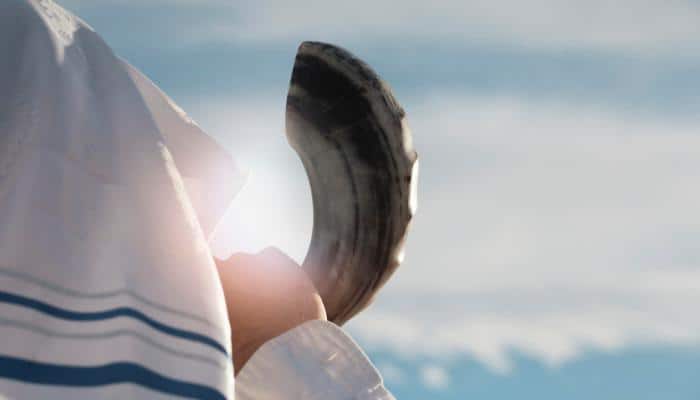
The Torah designates the tenth day of the seventh month (Tishrei) as the “Sabbath of Sabbaths,” the day that we call Yom Kippur, the Day of Atonement.
In the seventh month on the tenth of the month you shall afflict yourselves and you shall not do any work…. For on this day He shall provide atonement for you to purify you; from all your sins before G-d you shall be purified …It is a Sabbath of Sabbaths to you…..
Yom Kippur is described as the holiest day of the year because it combines the Sabbath prohibition against work, atonement from sin and the obligation to fast, described in the Bible as “affliction.” We ignore our physical needs and desires on this day and relate to G-d as if we were completely spiritual beings. On this day, G-d gives us the opportunity to be cleansed of our sins and to correct the past.
Contrary to most people’s perception of the day as very sad, the Sages describe Yom Kippur as one of the happiest days of the year. In a beautiful passage in the Talmud, Rabbi Akivah states:
Happy are you, Israel! Before Whom are you purified and Who purifies you? Your Father in heaven! As it says, “And I will cast upon you waters of purity and you will be purified.” And it says, “G-d is the hope (mikvah) of Israel.” Just as a mikvah (ritual bath) purifies the impure, so the Holy One, blessed be He, purifies Israel.
Although Yom Kippur is certainly a solemn day of self-reflection, it is also a day of happiness. This is the time when we can become free of the shackles of our past, when G-d gives us a special opportunity and ability to repent and change ourselves for the better. While on Rosh Hashanah we look forward to and pray for a good new year and commit ourselves to being better people, Yom Kippur focuses us on our past and gives us a chance to “turn back the clock,” to actually change our past.
The greatest event in history was, without doubt, G-d’s Revelation to the entire Jewish people on Mount Sinai. Very soon afterwards, however, mistakenly thinking that Moses had disappeared, the Jewish people built a golden calf. Many of the people worshipped the calf as an idol, although most regarded it a replacement for Moses, not G-d. This act, which our Sages likened to a bride committing adultery at her wedding, damaged the relationship between the Jewish people and G-d; the effect reverberated throughout history.
When Moses came down from Mount Sinai and saw the Jews dancing around the golden calf, he broke the tablets of the Ten Commandments G-d had just given him. Moses then turned to G-d and pleaded with Him for forty days not to destroy the Jewish people. Finally, on the first day of the Hebrew month of Elul, G-d told Moses to ascend Mount Sinai once again. There, Moses prayed for forty days more until G-d completely forgave the people, renewed His covenant with them and gave Moses a second set of tablets. It was on Yom Kippur that these second tablets were given because atonement and forgiveness are forever imprinted on the spiritual nature of this day. G-d decreed that this moment in time should be observed every year as the second giving of the Torah, a day which will always provide an opportunity for us to heal the rifts in our relationship with G-d.
One of the best-known features of Yom Kippur — sometimes the only thing people know about this day — is the fact that we are forbidden to eat and drink. What is the meaning and purpose of these prohibitions on Yom Kippur?
An anthropologist visiting a synagogue on Yom Kippur might think that since no one is eating or drinking for an entire 24-hour period, the congregants are all suffering terribly. He would probably conclude that the purpose of the fast is solely to induce suffering for the sake of atonement. These observations would completely miss the mark. It is true that on Yom Kippur there is an obligation to refrain from eating, drinking, washing for pleasure, using lotions or engaging in intimacy. A person observing these prohibitions it not, however, necessarily suffering. When I was a child I used to be an avid reader. I would become so engrossed in a book that I would not hear my mother calling me for supper and would be unaware of any hunger or thirst. (In Divine retribution, I now call my own children when they are reading and they too are unable to hear me.) As soon as I had finished the book, however, I would be ravenously hungry and thirsty because my mind was no longer focused on reading.
A similar phenomenon occurs for many people on Yom Kippur. They are focused on their prayers and repentance, on repairing, renewing and improving their relationship with G-d. When they are engrossed in the spiritual components of the day, they do not experience the sensations of hunger and thirst, just as a reader might not realize that he is hungry or thirsty until he finishes the book.
If the purpose of fasting is not physical suffering, what is it intended to achieve? The simplest explanation seems to be that fasting is a way of ignoring our physical needs and focusing entirely on our spiritual side. This is in marked contrast to how we often act during the rest of the year, when we tend to our physical needs, often neglecting (and sometimes even damaging) our spiritual selves. Recognizing that we have frequently indulged in such behavior, fasting impresses upon us that enjoying the physical world is a privilege we may not deserve. Rabbi Samson Raphael Hirsch explains:
Yom Kippur also teaches us that in consequence of our sins, we have, from the standpoint of strict justice, no further right to continue our existence and the gratification of our senses. We… therefore show ourselves on Yom Kippur for what we really are: spiritually poor. And in order to express this fact, on this day we… avoid any gratification of the senses…. For… by gratifying his senses on Yom Kippur, a Jew would be taken to indicate that he thinks he need render no account of his life and that he owes his existence to no one. Theoretically speaking, only a Jew who is perfect and has never sinned — and therefore has not jeopardized his right to life — would not need Yom Kippur. But then, where is there such a righteous person?
Another aspect of fasting is the removal of distractions and temptations in order to focus the individual on the essence of life and the service of G-d. In addition, fasting contributes to a feeling of humility, appropriate to one who is begging for forgiveness and is in the process of being judged. As the Sefer Hachinuch writes:
One of the kindnesses of G-d toward His creatures was to set one day a year to atone for sin through repentance… And therefore we were commanded to fast on this day, because food, drink and other pleasures of the senses, arouse the material [fusion_builder_container hundred_percent=”yes” overflow=”visible”][fusion_builder_row][fusion_builder_column type=”1_1″ background_position=”left top” background_color=”” border_size=”” border_color=”” border_style=”solid” spacing=”yes” background_image=”” background_repeat=”no-repeat” padding=”” margin_top=”0px” margin_bottom=”0px” class=”” id=”” animation_type=”” animation_speed=”0.3″ animation_direction=”left” hide_on_mobile=”no” center_content=”no” min_height=”none”][side of man] to follow his desires and can lead to sin. And they will overpower the pure soul whose desire is only to search for truth, which is the service of G-d, His ethics and His goodness that are the sweetest pleasures for one of wisdom…
In addition, it is not appropriate that on the day that he comes for judgment before his Creator, that he should stand with a soul full of its own importance and somewhat confused by eating, drinking and thoughts of physical pleasures…
Fasting can certainly be difficult, but it remains a primary obligation of the day, even if one does not think of or achieve any of the goals or ideals that we have just discussed. Still, it is important to keep in mind that the ultimate goal of the fast is, in fact, teshuvah, repentance.
-
Rabbi Mordechai Becher’s VLog on Yom Kippur 5774
The Thirteen Attributes of G-d’s Mercy
Rabbi Becher explores the significance of the 13 attributes of Divine mercy that we recite during this time of the year.
-
Harry’s Video Blog – Charity Saves From Death – Yom Kippur 5774
This is the best week of the year to give charity. You’ll get back much more than you give…
-
Rosh Hashanah Retreat
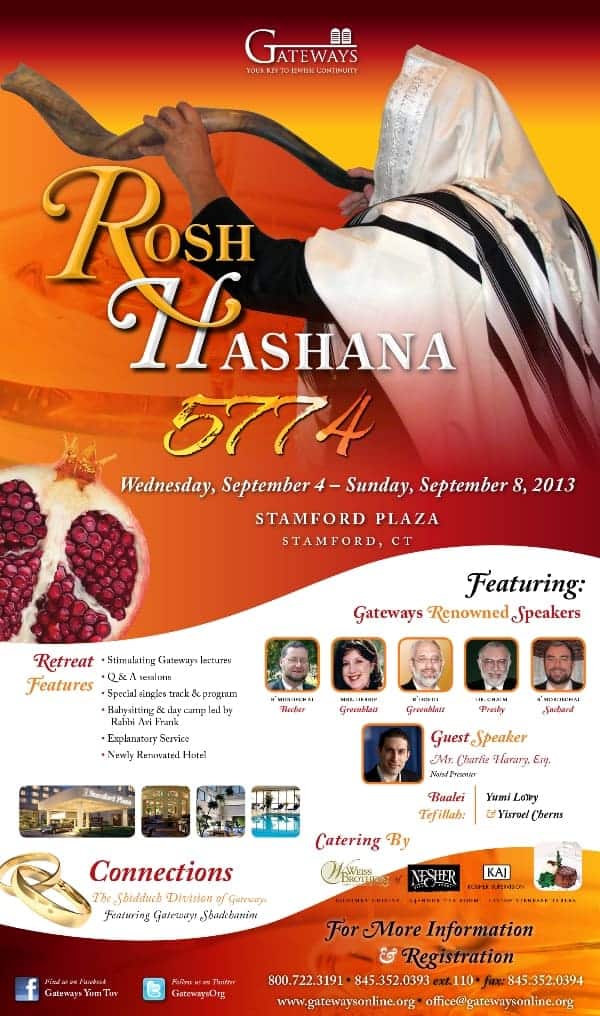
Join us at the Stamford Plaza Hotel for an inspirational and uplifting beginning to the New Year 5774.

-
Yom Kippur In Israel
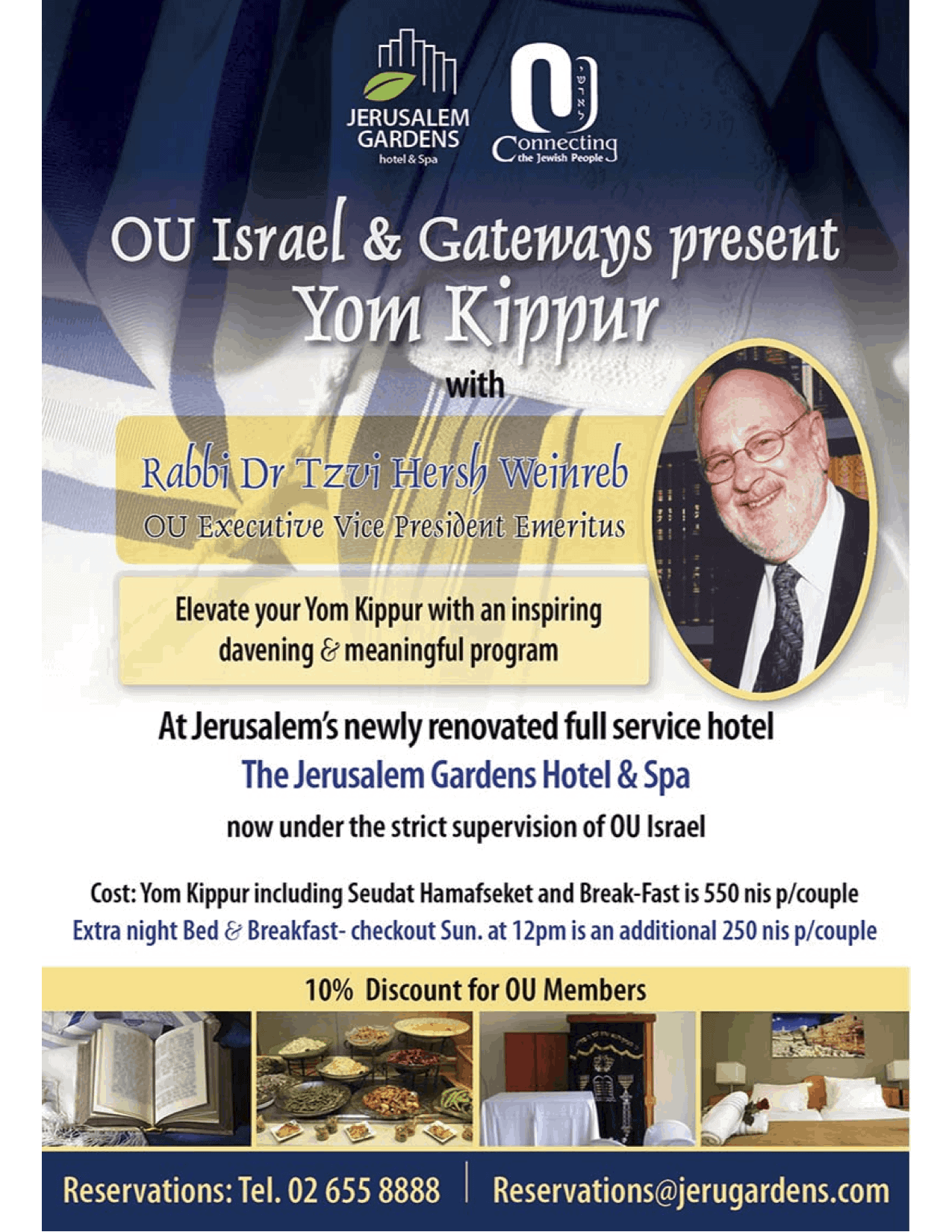
Join Gateways and the OU at the Jerusalem Gardens Hotel and Spa for an inspiring and meaningful Yom Kippur program led by Rabbi Dr. Tzvi Hersh Weinreb . The newly renovated Jerusalem Garden’s Hotel is a full service hotel and is now under supervision of OU Israel). Register now by emailing Reservations@Jerugardens.com or calling 02-655-8888.
