Leah names her fourth son “Yehuda,” drawing the name from a word meaning thankfulness. But why did she wait for her fourth son’s birth before thanking G-d?
Blog
-
Harry’s Video Blog – Another Brick in the Wall – Toldot 5774
Isaac digs three wells and names them. Why are they so significant?
-
Rabbi Mordechai Becher’s Vlog on Parshat Toldot 5774
The Macho Thug vs The Scholar
Rabbi Mordechai Becher discusses why did Isaac favor Esau, a macho thug, over Jacob, the wholesome scholar?
This week’s Vlog is dedicated in memory of Yitzchak Meir ben Lev HaLevi
View this video directly on Vimeo.
-
Sitting in the Tents of Torah
Jacob is described as “wholesome, one who dwells in the tents.” Rashi explains that Jacob dwelt in the tent of Torah and spent his time studying. (What exactly he was studying before the giving of the Torah is a matter of discussion amongst the commentaries) Like Jacob, one of the hallmarks of Jewish life throughout the ages has been a passion for study. This characteristic is so marked that for centuries we have been identified as the “People of the Book.” Judaism has never restricted academic learning to a particular caste, tribe or family. Torah study was and is the preoccupation not only of teachers and clergy, but of the entire nation. The renowned Jewish scholar of the 12th century, Maimonides, writes:
“Among the great Sages of Israel were woodchoppers and water-bearers, and some who were blind. Nevertheless, they engaged in the study of Torah day and night, and they were part of the chain of transmission of the Torah, person to person, back to Moses our teacher.”
Throughout history, Jews with widely varied backgrounds have been outstanding Torah scholars. Two of the greatest Talmudic Sages, Shmaya and Avtalyon, were descended from Sennacherib, the Assyrian ruler who invaded Israel and exiled ten of the twelve tribes. Onkelos, whose Aramaic translation of the Torah is printed in almost every Hebrew Bible, was a convert and nephew of the Roman Emperor, Titus. Judah the Prince, editor of the Mishnah, was a fabulously wealthy businessman; Hillel, a revered leader and president of the Sanhedrin was a pauper.
Among the great medieval commentators, Rashi was a vintner, Rabbi Yehuda Halevy was a professional poet; Maimonides and Nachmanides were both physicians. In short, the Torah is the universal inheritance of the entire Jewish people, regardless of their origin or social standing.
The obligation to study and teach Torah is emphasized repeatedly in the Bible and in the works of the Sages and the reward for this mitzvah is considered equal to that of all the others together. Jewish law is unequivocal in exhorting people to study Torah:
“Every Jewish man is obligated in the study of Torah, whether he is rich or poor, whether in good health or suffering, young and old, even if he is of an advanced age and very weak. And even if he was so poor that he was living on charity, and begging at doorways, and even one who must support a wife and children, is obligated to set aside time, every day and every night, for the study of Torah.”
Although the Biblical obligation of Torah study is directed toward Jewish men, women are not exempt from the commandment to study. The Code of Jewish Law rules: “Every Jewish woman is obligated to study all the laws of the Torah that are applicable to her.”
Commenting on the obligation of women in Torah study, the Chafetz Chaim, one of the most influential of scholars of the last century, stated:
“In the days that everyone lived in the place of their forefathers, and the chain of tradition was strong, it was possible to exempt women from study, since they could rely on what they had learnt and received from their parents. However, nowadays, when people do not live where their parents live, and the transmission of the Torah has been weakened, and especially since women study the languages and cultures of other nations, it is beyond any doubt, a great obligation to teach our daughters the Torah, the books of the Prophets and the Writings, and the ethical teachings of our Sages, such as the Ethics of the Fathers… and other such works…”
Non-Jewish observers have often noted with wonder the degree to which the Jewish people have taken the obligation of universal education to heart, and have made Torah study a central part of Jewish life. A Christian scholar visiting Warsaw in the early twentieth century recounted the following incident:
“Once I noticed a great many coaches in a parking place but with no drivers in sight. In my own country, I would have known where to look for them. A young Jewish boy showed me the way; in a courtyard on the second floor was the shtieble [fusion_builder_container hundred_percent=”yes” overflow=”visible”][fusion_builder_row][fusion_builder_column type=”1_1″ background_position=”left top” background_color=”” border_size=”” border_color=”” border_style=”solid” spacing=”yes” background_image=”” background_repeat=”no-repeat” padding=”” margin_top=”0px” margin_bottom=”0px” class=”” id=”” animation_type=”” animation_speed=”0.3″ animation_direction=”left” hide_on_mobile=”no” center_content=”no” min_height=”none”][combination synagogue and study hall] of the Jewish drivers. It consisted of two rooms — one filled with Talmud volumes, the other a room for prayer. All the drivers were engaged in fervent study and religious discussions… It was then that I found out… that all professions — the bakers, the butchers, the shoemakers etc. have their own shtieble in the Jewish district; and every free moment which can be taken off from work is given to the study of Torah.”
In religious neighborhoods around the world, thousands of people spend much of their spare time studying. Classes are offered in Hebrew, English, Yiddish, Spanish, French, Farsi and Russian. There are Talmud classes that meet before sunrise, women’s Bible study groups that meet every Shabbat afternoon and on weekday mornings, special programs in which parents and children study together at a synagogue, and public lectures attended by hundreds every Saturday night. Doctors, lawyers, accountants, refrigerator repairmen, storekeepers, university professors and police officers gather every evening to study Torah together. This scene is common in Jewish communities around the world, and was a widespread phenomenon in the lives of our ancestors, regardless of what was going on in the outside world. A 12th century monk observed:
“…the Jews, out of zeal for God and love of the law, put as many sons as they have to letters, that each may understand God’s law… A Jew, however poor, if he had ten sons, would put them all to letters, not for gain, as the Christians do, but for the understanding of God’s law, and not only his sons, but his daughters.”
[/fusion_builder_column][/fusion_builder_row][/fusion_builder_container]
-
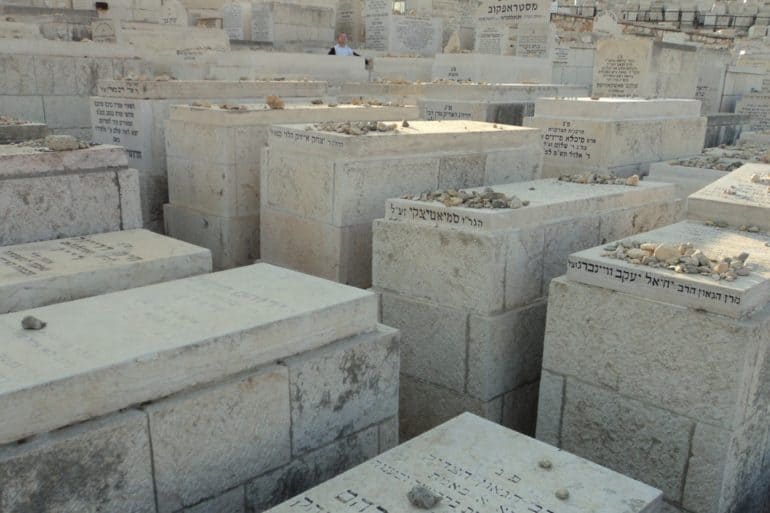
The First Jewish Burial
In our Parsha, Chayei Sarah, Abraham buries his wife Sarah in what was the very first Jewish burial. Why do we bury the body? In Tibet bodies are left out to be eaten by birds; in many societies bodies are cremated. Why does Jewish law insist on burial? The answer lies in our attitude to the body and soul. The human body is the vehicle that God has given the soul in order to fulfill its task of perfection in the physical world. The body and the soul are partners in this task and therefore the body is considered to be holy and sanctified. Just like a worn out Torah scroll is still treated with respect due its prior status as a container for holiness (the text of the Torah), so too a dead body must be treated with respect because it once was a container for holiness – the soul. The burial itself returns the body to its origin as the verse states in Genesis, “By the sweat of your brow shall you eat bread until you return to the ground, from which you were taken – For you are dust, and to dust shall you return.”
Paradoxically the once holy body, when it loses its life force, the soul, becomes the ultimate source of impurity, tumah. A dead body imparts a spiritual impurity through contact, and even through being under the same roof. The Torah is telling us that the material world, when it is totally devoid of spirituality is dangerous and polluting, hence the empty vessel of the body, now without the soul, is impure.
The impurity is also related to the confusion and illusion surrounding death. The Sages relate the word tumah (impurity) to the word timtum (confusion). A spiritually sensitive person experiences confusion and a feeling of impurity when he or she comes into contact with, or even proximity to a dead body. We know that the human is essentially a free-willed being, spiritual in nature and with the power to master the physical world. When we see a corpse, we see the physical overpowering the spiritual, we see only the material side of the human and we become confused and depressed. That which we thought was lofty and eternal seems to be merely decaying flesh. In truth, the essence of that person lives on, but the impression of our senses is so overwhelming that we forget that idea, and we only focus on death as the end of everything, as the final victory of earth over heaven. It is this confusion that lies at the heart of the concept of impurity, tumah.
There are two Biblical commandments pertaining to a dead body. After talking about a criminal who has been sentenced to death, the Torah states that:
You shall not leave his body overnight on the gallows, rather you shall surely bury him on that day, for a hanging person is a curse of God, and you shall not contaminate your land, which God, your God, gives you as an inheritance.
The commentaries explain that since the human is created in the “image of God” and is the only being that has similarity to God, then treating his corpse with disrespect is a disgrace to God. The verse above obligates us to bury the body (“you shall surely bury him”) promptly (“you shall not leave him overnight”) and to treat the body with the utmost respect (“for a hanging person is a curse of God”).
The Talmud, based on this verse, rules that one may only delay the burial of the deceased for the honor of the deceased. If the delay was in order to obtain the necessities for the burial, or for relatives to be able to attend the funeral, for example, then it is permissible. In addition, there is a prohibition against desecrating the body, and a prohibition against deriving any benefit from the deceased. The body must be kept intact for burial, and the entire body must be buried; cremation, embalming and autopsies are all forbidden by Jewish law. (If a life may be saved by performing an autopsy, for instance, in the case of a suspected contagious disease, or to obtain an organ for a dying patient who is before us, then it is permitted, in accordance with the principal that the saving of life overrides almost all the commandments. Obviously, in all cases a competent Rabbi should be consulted.)
The body is washed in a very specific way, known as tahara, purity, and it is never left alone from the time of death until the burial (shmirah – guarding). The body is then wrapped in plain, white cloth shrouds (tachrichin) or in a tallis (a prayer shawl that has been rendered unsuitable for fulfillment of a mitzvah, as an indication that the deceased is no longer obligated in the mitzvot).
Jewish tradition requires that the body be buried in a way that it can decompose and “return to the earth” as quickly as possible. Therefore, a plain wooden coffin is used, mausoleums are not allowed, and anything made of metal, concrete or impervious materials is prohibited. In Israel it is customary to bury the deceased without any coffin at all, and outside of Israel there is a very widespread custom to place some soil from the Land of Israel inside the coffin. The deceased should be buried in ground that is consecrated for the sake of burial, in a place where his or her fellow Jews are also buried. It is also customary that people attending the funeral take turns putting soil in the grave to personally honor the deceased by fulfilling the mitzvah of burial.
Abraham also eulogized his wife Sarah. It is appropriate for a Rabbi or a relative to eulogize the deceased before the burial. The primary reason for the eulogy (hesped) is to honor the deceased by expressing the depth of the loss, our admiration and love for the deceased and by extolling the virtues of the deceased. The eulogy is also meant to move people to tears and to mourn for the deceased. Since the main reason for the eulogy is the honor of the deceased, if he or she requested not to eulogize them then there should be no eulogy. There is in addition, a component of honor for the survivors, as well as an opportunity to inspire people to emulate the good actions of the deceased. The Code of Jewish Law writes:
It is a great mitzvah to appropriately eulogize the deceased. It is correct to raise one’s voice, say things that will break people’s hearts in order to increase the weeping and to speak in praise of the deceased. One should not, however, exaggerate the praise excessively; rather, one should mention the positive characteristics of the deceased and embellish them slightly.
-
Rabbi Mordechai Becher’s Vlog on Parshat Chayei Sarah 5774
The Importance of Hebron.
What does the city of Hebron teach us about the Jewish people?
-
Harry’s Video Blog – Shock of a Lifetime – Chayei Sarah 5774
Rebecca’s first encounter with her husband Isaac leaves a long-lasting impression…
-
Harry’s Video Blog – I Don’t Want to See the Boy Die – Vayeira 5774
Tune in for a novel explanation of a deeply troubling scene in Genesis chapter 21 involving Abraham’s second wife, Hagar and her son, Yishmael.
-
Modesty, Shmodesty! As Long As You Look Good!
In this week’s Torah portion, our matriarch, Sarah, is described as beautiful, as other great women in the Torah in numerous places. So clearly, beauty is considered a quality, and yet, we know that modesty is also considered of great value in Judaism. So this week we will talk a little about modesty.
He has told you, O man, what is good! What does God require of you; but to do justice, to love kindness and to walk modestly with your God?
Modesty, (tzniut) is an attitude to life that informs the way we speak, walk, think and dress. It dictates that we not put every quality on display; not flaunt our wealth, beauty or success; and recognize that the inner, spiritual world is more important than the external world. These ideas are most overtly expressed in the way we dress.
Clothing is used by people all over the world; it distinguishes humans from animals. It testifies to the inner dignity and honor of the human being, who possesses a Divine soul. That is why one Talmudic Sage used to refer to his clothing as that which gives honor.
Clothing and appearance play important roles in society. They are used to identify the wearer with a particular group or ideology; they may express one’s status in society and they often serve to enhance the wearer’s beauty. When choosing clothing, a person may decide to emphasize the physical self and conceal his or her spiritual essence or to reveal more of the spiritual self by de-emphasizing the physical. The way a person dresses can either send the message, “Look at my body, this is me!” or it can declare, “Listen to what I say, I have spiritual presence.”
Our clothing affects not only the way others perceive us, but also the way we perceive ourselves. Do we identify primarily as a body (e.g. “The Material Girl” which is what Madonna called herself for about 10 years and Jesse “the Body” Ventura) or as a soul with intellect and emotions?
This is not to suggest that one should dress in an unattractive manner. On the contrary, the Torah instructs always to present a pleasant, neat and dignified appearance. In our interactions with other people, our clothing should serve to focus attention on the face and the personality, not the body.
A person’s face is the one part of the body that reveals his or her inner spiritual essence. The Hebrew word for face, PaNiM, has the same three-letter root as PNiM, meaning “inside” — because the face is a window into one’s inner being. For this reason, the Jewish tradition of modesty never required, or even encouraged covering the face. The Jewish laws of modesty do, however, require that neither men nor women dress in a provocative or suggestive fashion, or in clothes designed to highlight the sexuality of the body.
For several reasons, special emphasis is placed and more stringent standards apply to women in the area of modesty. Anything powerful must be used responsibly and for the right purposes. The power and impact of women’s beauty is mentioned numerous times in the Torah, Prophets and Writings. It is something that should be treasured and used appropriately, in a loving relationship between a husband and wife. The root of the word for modesty, (tzniut), also means to “hide” or “treasure;” by dressing modestly, a woman demonstrates that she treasures one of her great powers, her beauty. Observing the laws of modesty also helps to prevent a woman from being turned into the object of someone else’s sensual gratification. It encourages interactions in which people are judged not by their bodies, but by who they are inside.
We are not ashamed of our bodies, nor do we look at them as impure; on the contrary, we care for our bodies and value their beauty. We believe, however, that the appropriate time and place for using that beauty and sensuality is not in the public arena, but in the privacy of a holy and loving relationship between a man and woman, a relationship that is spiritual and emotional, as well as physical. As Nachmanides writes, “When husband and wife are intimate… there is nothing so holy and pure… God did not create anything that is ugly or shameful. If the reproductive organs are said to be shameful, how can it be said that the Creator fashioned something blemished?”
It is one of the great tragedies of our times that many women dress in ways that are calculated to please the casual male spectator. By dressing this way, they cultivate an image of themselves that is based entirely on their external appearances and their value as an object of pleasure to a man, when in reality, the truest beauty of a Jewish woman is internal. As the verse in Psalms informs us, “The entire glory of the daughter of the King is within…”
This is one reason that the Torah actually prohibits men to stare at women for their pleasure. When a man disregards the fact that a woman is much more than a beautiful body or pretty face, and focuses on her for his own pleasure, he objectifies and degrades her.
Often, the way a person dresses indicates whether or not they treasure that internal, essential self. A Jewish woman dresses to look attractive, but she does not dress to attract; she may wear elegant and beautiful clothing, but the message of her clothing should be that there is more to her than meets the eye, that her beauty is not merely skin deep.
-
Rabbi Mordechai Becher’s Vlog on Parshat Vayeira 5774
What’s so funny about the Jewish people?
Rabbi Becher examines why our ancestor called Isaac is named after laughter?
View this video directly on Vimeo.
This week’s Vlog is sponsored in memory of Mildred Glatter, Malka bas Yisroel.